Showing posts with label Dementia Resources. Show all posts

Thursday, May 5, 2016

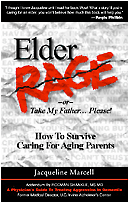
Book Review: Elder Rage by Jacqueline Marcell

book_cover.gif

You know, most books dealing with dementias tend to be technical, somber, memoir-like.  It can be difficult to read many of them because they help us as guides to tend to the needs of the one we have who is afflicted with the disease, be it Alzheimer’s, Vascular, Lewy Body, Parkinson’s, or any of the others.  So I wasn’t sure when I saw the title of this work as to whether or not I really wanted to delve into some of the darker reaches of the disease.  But, it was listed as a best-seller, so I thought I’d give it a shot - after all, it wasn’t that expensive as a kindle book, but then I also added it to my Audible library.  I’m so glad I did.

The author, Jacqueline Marcell (who also performs the Audible book) had been working as a producer, among other titles, in the entertainment industry in Los Angeles.  Her parents, retired, lived in Northern California - somewhere around the Bay Area.  They had a good relationship, and when she found herself out of a job and her parents sent an SOS, she realized she had the time and the means to zoom up north and help them out.  

Wow!  She was unprepared for what was to come.  What must have been a complete nightmare is expressed with a generous amount of humor and tenderness.  What makes it even better is the events touched a nerve with me in the truths that were revealed and dealt with, even if the situations were quite different from mine own.  

There is love and compassion, embarrassment - be it dark and tender (you may understand if you’ve read it) or just outright truthful, but overall Ms. Marcell outlines the story of a child discovering how to handle a medical system that has no interest in involving itself when it should be dragging the bull by its horns.  

She is confronted with how to manage her father's driving?  Honestly, this seems to be one of the more difficult aspects of caring for someone in their own home - especially if they are in denial.  She uses a club on the steering wheel, which is brilliant - I'd not even thought of this! 

Then there are the tales that seem so true - but really aren't.  I had tried to think of ways to get someone in with Mom but knew they'd be kicked to the curb in no time, if they even made it through the front door. 

The hallucinations, the hoarding, the need for control - are all there.  There is even the physical abuse that comes from the frustration.  There is so much in here that is relatable!  Of course, we all have our own spins on what has occurred, but it's so nice to read that someone else is struggling, as well, and making it work!

The denial of the father that anything is wrong becomes quite a problem - it doesn’t help he has an anger management problem that keeps resurfacing and becomes one of the greatest obstacles in Jacqueline’s attempts to get help for both her folks.   Believe me, when I tell you that this anger and denial is real - it happens and pits you between the one(s) you grew up to honor and obey as parent(s) and your need to begin to parent them.  It’s truly heartbreaking, but when you hear this story (completely relatable) and compare it to your own experiences, then you really understand.  
What really caught me was the lack of help from the medical community; they refused to listen and provide any guidance or help.  I can recall Mom’s doctors phoning me for help when I had no idea what was going on.  So, this series of events really touched me.  Had it not been the realization of the final doctor we had telling me Mom needed to be placed in observation I’d have never really had an idea of what to do - the rest of our story fell into place; for Ms. Marcell, though, the story just continues - that is until she is led to the Alzheimer’s Association.

Once she begins working through the information and finds resources she realizes the nightmare may finally be over.  Our journey took another path, but I hear it all the time how lost people are without the right resources or guidance to find out what they can do for their loved ones.  

The appendix of the book is rife with resources (in the Kindle version, these are accessed by tapping the links - I’ve no idea about the print versions), as the author wishes to help others who might be finding themselves in similar plights with no angels in sight.  

While this book may, at times, seem as though it’s a bit too entertaining, stick with it.  Remember, humor is something that is necessitated by the circumstances in order to maintain good mental health for the caregivers and family.  

I would recommend this book as it helps the reader understand more of the struggles more of us contend with than are willing to admit.  As our elders begin to lose their independent abilities they also begin to find elements of life frightening, and they just can’t understand they why or how of the adjustments.  

I’ll be interested to hear how others find this book.  I do know of people who have enjoyed and learnt a great deal from the others I’ve posted in the Recommended Reading section of this blog and hope this one will join the canon.

Elder Rage - or - Take My Father...Please.  Marcell, Jacqueline.  Impressive Press. 2001.

You may also find more of Jacqueline's Resources at: ElderRage.com

Tuesday, December 30, 2014

A Checklist For Your Parents or Loved Ones If You Suspect They May Have Dementia, Part II

6.  A Neurologist
     What's the difference between a doctor and a neurologist?  Well, a medical doctor can take care of the body, and work with the neurologist.  They run the physiological tests that keep your loved one in good health.  It's important you form and maintain a strong bond with them, and be sure they understand the form(s) of dementia your loved one is experiencing, or demonstrating signs of.
    The Neurologist should be one who understands the differences between forms of dementia.  If they don't, then keep searching and ask others for referrals.
    The Neurologist is able to determine the benchmarks of the disease, as well as the direction you're headed.  They offer support, and are also a conduit between the patient and the doctor.  Be sure both doctors are communicating!!!

7.  Care Options.
     Know your Care Options.  In Portland, there are just under 200 care facilities, or so I've found, which claim to have Memory Care.  That doesn't mean there are just under 200 real memory care facilities.  Also, speak with the doctors and determine and question the ability for foster care.  When Mom was first taken to St. A's, there was some talk that going through some organizations would take her out of memory care and place her in a foster care;  this would have been absolutely disastrous!  However, there may be those for whom this would be ideal.
      With Dementia Patients, Memory Care comes in many forms.  Mom suffers from anxiety which demands she has an open and the ability to move about without feeling confined.  One of the first centers I'd visited would not have served her well, despite their reputation, nor that they charged much more for less.
      Also, with LBD patients, there must be a limit as to the number of residents in the living facility.  It's not a matter of "The More the Merrier".  Mom has 12 in her cottage (her included).  The other cottage mimics the number.  Dementia patients need to have smaller numbers about them.  They cannot deal with crowds.  Mom's number is about the limit.
      There is room to move about, and the caregivers are wonderful.  They are able to give me up-to-the-minute reports on Mom.  They also have a great sense of humor when it comes to dealing with her demands.
    How do they communicate with you?  Visit the home when you can at various times to get a sense of the atmosphere, and consider if this is truly where they could spend the rest of their days.
    This leads to another issue:

    7A.  Does the Care Facility Care Up-to-a-Point?  Or Do they care all the way through to End Of Life?
The less you need to move your loved one, the better.  Luckily, Mom will be cared for until she passes.  Other facilities will keep patients until they become physically incapable to move about without assistance;  at this time, they will need to find another placement within a small window of time.  Is this something you believe is in the best interest of your patient?    Wow.  That's a heavy one!
    7B.  How are Medical Visits taken care of?  Is there Medical Help In-House?  Do they drive the patient to the visits?  How is all this managed?
    7C.  How Are Privacy Issues Managed?  Mom refuses to have anyone near her while she showers.  So, we have a plan in place that they check in on her to ensure she's bathing, but they do not venture into the bathroom, unless she's in there for a certain amount of time with no signs of movement (10 minutes).  This way we're all assured she's bathing and keeping her sense of dignity and privacy.  Will the facility be as flexible as this?
    7D.  Room to Move.   Are there gardens and ways for the patients to get outdoors and move around?  Between Mom's cottage and the other, patients are encouraged to go outdoors and venture into the other cottage, while the weather permits.  The same staff manages both sides, so there isn't any chance of someone being "lost" on either side.  Patients can also view television and movies on both sides, depending on their tastes, if this is an option.
     7E.  Does the facility provide Physical Therapy and Other Activities?  Mom has opportunities to exercise, go to "music concerts", Bible Study, Book Groups, and Bingo, among other activities, as long as she's accompanied to the main part of the facility (the non-memory care).  This encourages physical and mental activity which is crucial, rather than allowing her to just sit about and do nothing.  There is great encouragement for her.

8.  An Elder Law Attorney.
      This, too, is crucial.  The attorney should be able to answer your questions regarding Medicare/Medicaid, payments, how to work within the system, Pay-Downs (in order to receive Medicaid benefits toward residential and/or in-home care), an all that.  Your attorney should also understand all the workings of the system and be able to communicate that to you in an understandable and caring manner.

9.  An Ombudsman.
     Any care facility or any facility that deals with the elderly will and should have this information readily available to you.  This is a volunteer who works with the resources and can provide support when it is needed.  For example, if there is an issue in regards to care at a specific facility, then you call on the ombudsman in order to facilitate and achieve the necessary results.
    Mom was put in touch with the ombudsman for her area after she arrived at St. A's.  He came in and listened to her concerns.  She told him she had been kidnapped and forced into the facility for no reason whatsoever, despite all the evidence from the previous hospital that dictated she enter into a memory-care.  After he left, she felt her concerns were heard, even though nothing came of it.  However, they will run an investigation should those concerns merit such an action.  
   That number, for our ombudsman, is located just inside the entry for the cottage for any and all to see.

10.  In-Home Care Resources.
     This can be critical, especially if you're caring for someone in-home and need to have some respite.  I know of Visiting Angels, who charge a nominal fee, and can do light housekeeping, and other jobs, while also doing activities with your loved one.
    There are also Adult Day Care facilities around, as well.  These can help with activities, and allow you drop off your loved one while you run away to the spa, coffee, or back home for some needed rest.  With my grandmother, who had AD, this was a life saver, allowing my parents to maintain their jobs, and also run errands  or have some down time.

11.  Last, but not least, Support Groups for You.
       If you go to the Alzheimer's web page, or the Lewy Body Dementia Association website, you will be able to locate support groups, hopefully (there wasn't one within 150 miles of my location until last Spring), in your area.
     These, not only, let you know you're not alone, but also provide great resources and feedback from others in your situation.  We have, too, a social worker who can run interference should the need arise, but also provides resources available, as well.
   

I know these feel long-winded, but I hope they provide you with some idea of some necessities required in order to help those you are involved with with Dementia.

To be forearmed is to be ready for any next steps.

I hope I didn't (although I realize I probably have) leave anything out.


Sunday, December 28, 2014

A Checklist For Your Parents or Loved Ones If You Suspect They May Have Dementia, Part I

Because it's the holidays, and I won't be able to conclude the week until tomorrow, with Mom, I've tossed in this piece, which will be the theme for this week.  Watch for the second part of this post on Thursday, and the usual Sunday post, tomorrow, Monday, 12/29/2014.  


For years we suspected that Mom wasn't quite right.  But, when you're a kid, you don't really know much about dementia - in fact we knew nothing  (Okay, a bad joke, but it was true).  Alzheimer's hadn't really come to the forefront, and if an elderly relative was "daughty", then that was attributed to aging and the aging process.

Today, more is known of Dementia and more than just Alzheimer's (AD).  Now, we have Vascular Dementia, Sundowner's, Alzheimer's, Parkinson's Disease Dementia (PDD), Lewy Body Dementia (LBD), and more.  They're all different, yet they all share the element of Dementia.

More and more of the aged and aging are developing symptoms, and we never know just who or when.

So, with that in mind, it seems practical to begin to put together a checklist for those of you who might want to begin arming yourself with resources.

1.  Durable Powers of Attorney.
      This is something that could very well be the most crucial document in your possession.  This allows you to manage any and all accounts for your patient, with the understanding it's all benign and you are working with their best interest at heart.

2.  Medical Powers of Attorney.
      This is something about which you should speak with your loved ones.  Do they want a DNR?  What are their wants medically?  What sort of End of Life procedures are they asking for?  Yes, a rather uncomfortable conversation, but crucial.
      Also, this allows you access to the physicians and to be present in procedures.   Doctors are able to converse with you and help you in determining the best courses of action, and they can also work with you as the disease progresses.
        With the HIPAA rules, this is also a must have!

3.  A Physician Who Understands and Acknowledges the Patient's Needs and Wants.
     Have a conversation with your loved one's physician about medications and dementias.  Find out what they actually know, understand, and determine whether or not they will be a vehicle to help move forward, or a hindrance.  A well-meaning doctor who knows nothing could do more damage than good, and this could decrease the quality of life for the loved one.

4.  A list of medications.
      Know what medications your patient is using, as well as the dosages.
      Research those medications using WebMD.com, or another that your physician or pharmacist refers to you.  You should be aware of the side effects, as well as the usages.  Do some cross-referencing, as well, to make sure that medication is the best one to be using.
     For example, many LBD patients are using Risperdal, and there is talk of a patch with Exelon.  Some see the benefits, and others are experiencing negative side effects.  Mom is on Quetiapine, and this is the best for her.  So, there are options.  Just be sure you know which will do the best, and which will not do damage.

5.  A list of Dementia Resources.
     Go online.  Visit the NIH.gov and roam around.  Visit the LBDA.org site.  Visit the Alzheimer's Association site.  Look at the Alzheimer's Reading Room, and other sites associated with the forms of dementia.  There are quite a number of good blogsites out there, as well, and people share quite a bit.