Sunday, December 13, 2015

The Coaster Continues - OR The Week Ending 12/13/2015

What a wild ride we’re on!  This week has certainly seen a great deal of change in Mother, and to be honest, some is great!  I’ll try to give you the update and make it as interesting as I can:

The beginning of the week, Mom was making some attempts to walk, but also found moments when her wheelchair and recliner were better.  She rested a great deal and still nibbled on her food.  

By Wednesday, when Connie and Jean came to visit, she was not at all “sparklie”.  She was tired and her voice was quite low.  She wasn’t able to say much, and what she did say tended to be irrelevant to the topic at hand.  She wasn’t much interested, either, in her food.  And, when the time came for her to go in for her shower, she complied and went off with Morina, later joined by Jennifer, the aide.    There wasn’t much more for the RLC duo to wait for, so they headed out into the wicked morass of rain to go home.

By Saturday, Mom had begun eating more.  Her alertness had picked up, as well.  She knows she likes Leddy, but she doesn’t recognize her by name, any longer.  
IMG_20151213_132913016.jpg
Mom has also begun walking more - and they ensure she is using the walker when she does, as her balance is quite weak.  

Her voice is a bit stronger and, once in awhile, she’ll state something that demonstrates her presence in the here-and-now.  This creates a feeling of well-being for the time.  

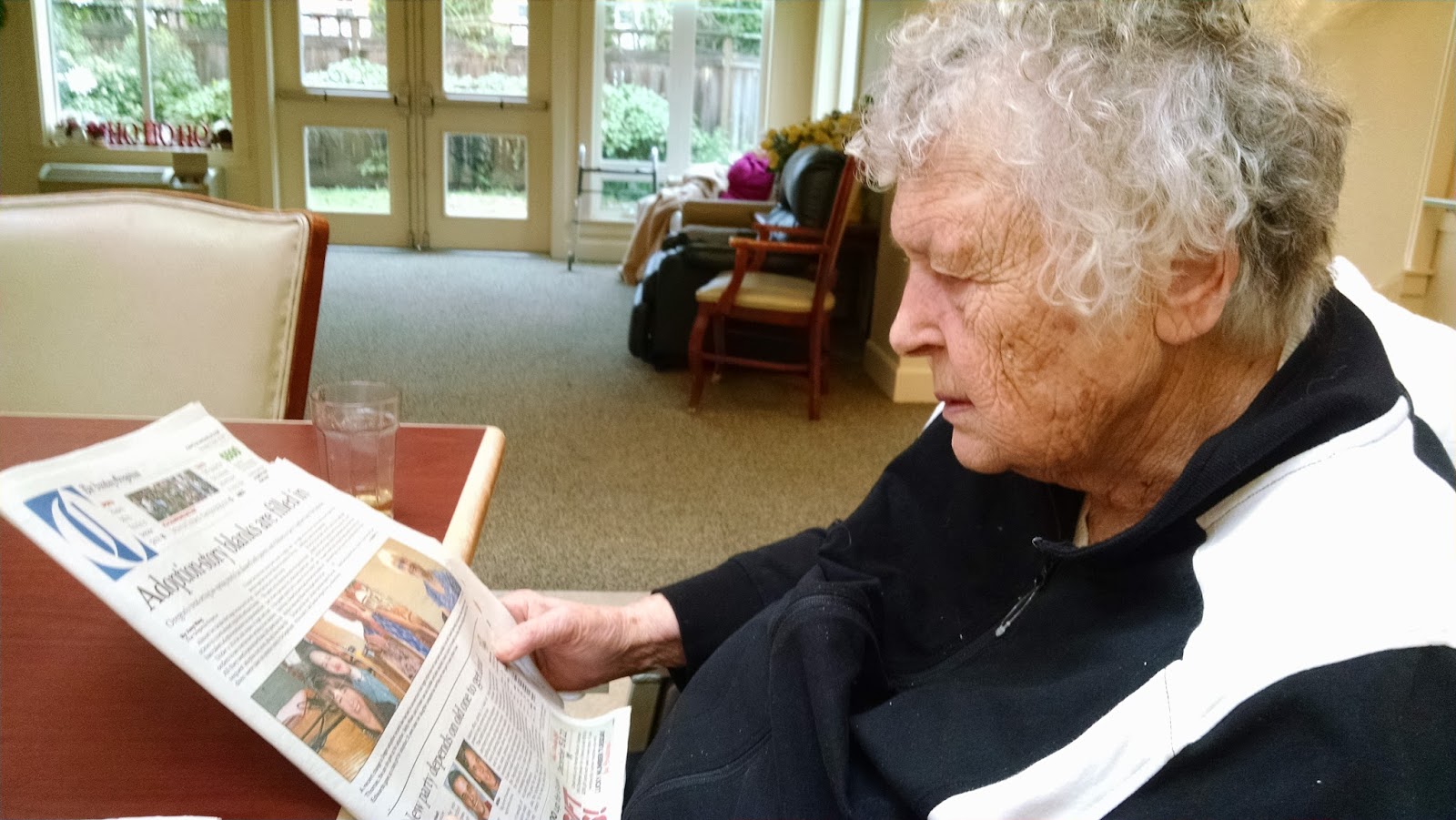
She enjoyed reading the adverts in the paper, this morning as I came to visit, albeit briefly (I’ve been ill with the flu and tried to keep as far from her as possible - but I had to replenish her supplies).  She was bright and happy to see me and then turned her attention to the paper and just as soon forgot I was there.

It is said that Lewy Body Dementia is a roller coaster and it’s only been since September or so, that we are beginning to understand the analogy.  She declined quickly, so we began hospice.  She returned to the living and just as we were about to take her off hospice she plummeted.  Now, the coaster is climbing again to another height, but it’s not as high as we’ve seen - in fact, this one is not high - but it’s still an elevation.  These are the times we smile and enjoy the moments while they last, hands in the air but the sounds aren’t of elation, but of breathing and prayers.

Tuesday, December 8, 2015

Book Review: Activities 101 for the Family Caregiver: Dementia


I bought this book last summer in an attempt to figure out some ideas as to how to better engage Mom.  Well, at the time what I truly wanted was something that would help me help her, as well; but this book didn’t quite fit the criteria I was hoping to find.


However, in retrospect, and upon re-reading it, I found a most wonderful resource for the population who are wondering what to do, or what to make of the predicament of having a loved one who has been diagnosed with dementia (there are other books, too, in which they cover Parkinson’s, Frontotemporal Lobe Dementia, Lewy Body Dementia, How to Engage and How to Live) these would be most welcome resources for those who are searching for something that would help lay the path and instruct on the necessities for caring for their loved one(s).  


To give the reader an idea of the book’s layout, I will list the table of contents
  1. Activities, Their Benefits and the Family;
  2. Dementia Overview and Symptoms;
  3. Home Preparation;
  4. Information Gathering and Assessment;
  5. Communicating and Motivating for Success;
  6. Customary Routines and Preferences;
  7. Planning and Executing Activities;
  8. Activity Categories, Types, Topics and Tips;
  9. Review.
There is also a substantial index and list of resources for further investigation at the end of the book.  


While the book is not wordy, rather pithy, it reads very easily, taking into account that less is more and those struggling to understand their situation need to be fed information in a simple and straightforward manner.  


Even after dealing with Mom’s dementia for 2.5 years or more, and now dealing with the final stages, I found myself learning.  


The book is the product of R.O.S. Therapy Systems, which helps caregivers venture along the path of working with patients suffering from forms of dementia, Parkinson’s, Stroke, and a variety of other maladies in which the brain and functions suffer.   It is the first, I found, of others, including lesson plans, activities, and there is, indeed, a store there in which all their products are available (I bought mine at Amazon.com).  


Had I been sane enough to have bought this book at the beginning of the journey with Mom, it may have helped me in many ways, whilst giving her the benefits of the activities and, perhaps, slowing the progression of the disease - however, this is something that will remain a mystery.  


To be honest, I would suggest this book first, or even the book dealing with Lewy Body Dementia (should that be the diagnosis).  As I stated earlier, it’s a quick read, and lends itself to teaching the reader quickly.  If only I’d found it so much earlier.


Silknitter, Worsley.  Activities 101 for the Family Caregiver - Dementia.   ROS Therapy Systems.  Greensboro. 2015.

Sunday, December 6, 2015

Slowly Descending OR The Week Ending 12/06/2015

IMG_20151204_111055189_HDR.jpg
This week Mom was tired.  Very tired.  The only answer is that her body is beginning to shut down.  She is alert in the morning hours - until about 10 am.  After that, it’s in and out of slumbers - some 30 seconds and others continuing on for some time.  
Monday, Mom was presented with a new wheelchair - and a cushion.  This was a much larger chair that allowed her to relax a bit more easily.   She had an alright day, she nibbled here and there, but didn’t really care for much to eat.

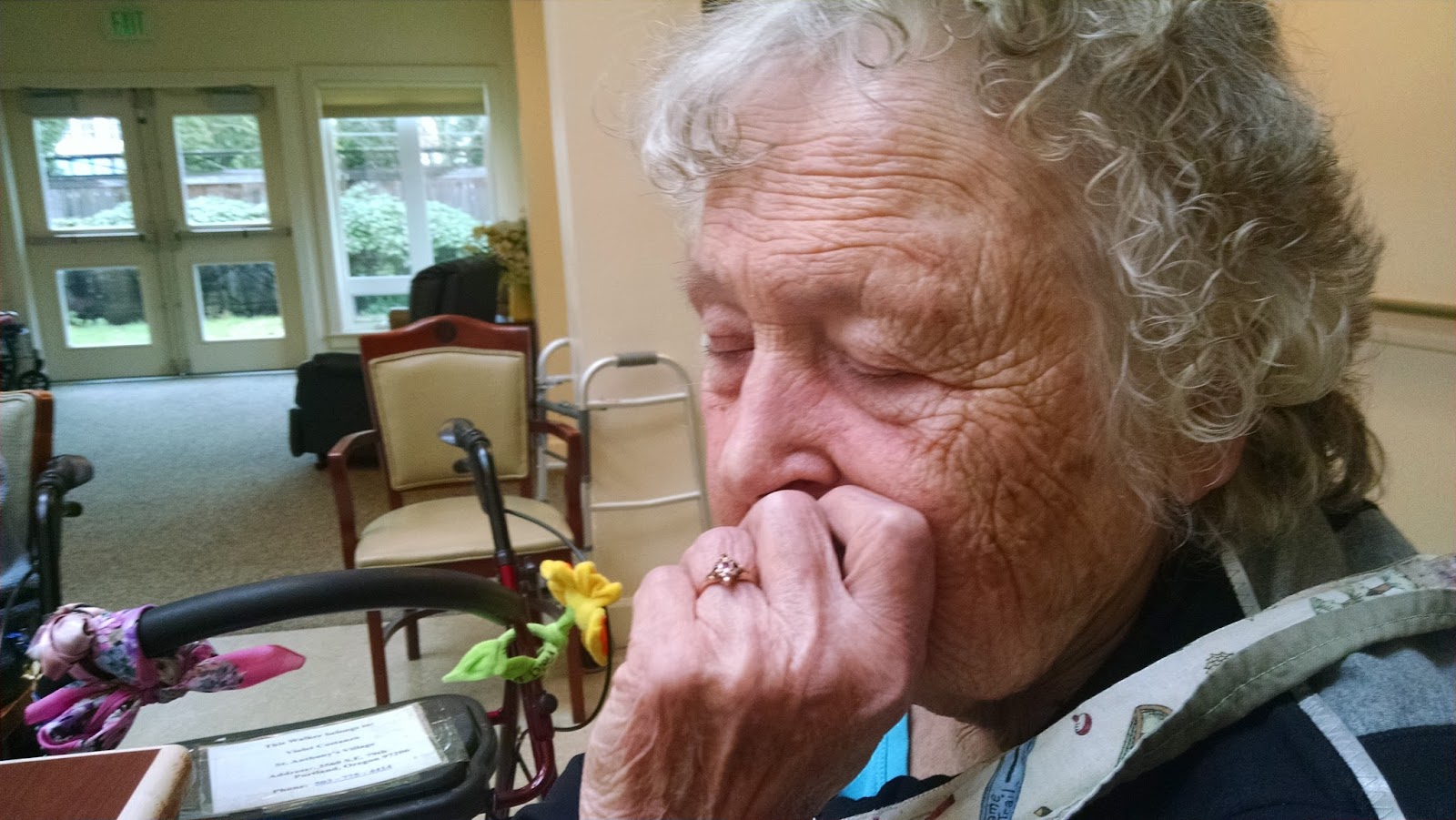
Tuesday, Mom had a somewhat busy day.  She was given a shower - and she didn’t even fight the idea - so she was quite clean and spruced up.  Later, she went to the salon where she was given a wash, clip, and a blow-dry.  She wasn’t quite thrilled with the idea of people snapping her photo, as you can see below:
download_20151206_131505.jpeg

And, yes, she is slumping quite prominently.   They are able to use the wedge pillow I bought for her to help her lean forward toward her plate at mealtime.  This helps her posture, but she’s not very thrilled with it.
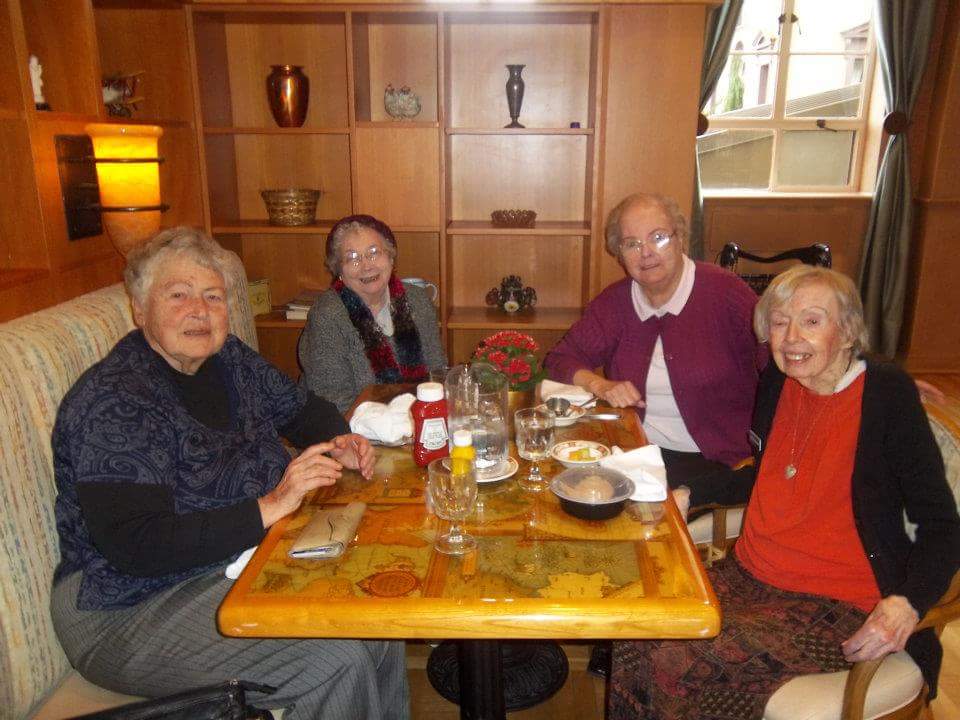
Wednesday, the RLC came for a visit.  Below is a snap of the three of them nearly 5 years ago - what a change you can see in Mom!

download_20151126_081036.jpeg
On the day this was taken, by Jean’s daughter, Christine, Mom forgot where she’d parked at Mary’s Woods, and was driven all around until they located the vehicle.   They were visiting their friend, Martha Lou, who passed three years ago.  

Here is a snap of the four of them on that day:
12294861_10207045008379124_6423628438508483998_n.jpg

My, how time flies!

But, here is the report submitted by the two genteel ladies:  

Connie and Jean arrived at noon, saw Norma at her usual table, but this time another resident,
Connie, and her daughter, Colleen, were there, too.  We three visitors chatted easily, with the two residents looking interested--I hope. Resident Connie had lived in North Cottage; did not ask then why the change. She wore a big soft "collar" around her neck, which obviously bothered her.
Norma was wearing her warm maroon shirt, with light blue pants. We both admired her pretty hair, always with curls.  Did Barbara cut it? I'm never sure.
Nurse Noelle joined the group for a while, then left for most of our time there. We saw her come in later.
Connie had brought a small catalog with colorful pictures of lovely, expensive clothes.  We three looked at some of the pictures, commenting on them and whether we liked them, and how expensive they were. Connie had brought the Wall Street Journal, too.  Norma was most of the time listening and offering a comment, which was often a thought she had but could not quite express.
Lunch was macaroni and cheese with pieces of chicken.  Orange segments and cooked carrot slices were on her plate, too.  Norma ate the orange pieces and about 4 chicken bites and a few carrot slices. When Jean started to feed her, she accepted it. We continued on with our chatting.

We were not paying attention to Norma and her glass of red liquid; she drank some, then tipped the glass so the liquid was on the floor. Jean got paper towels to wipe it up; Elsa finished up.  I hope Dollar Tree has a plastic cup with a hole in the top for a bendable straw.  Elsa said they have the straws at St.A's.
Norma stayed in her chair, with no signs of wanting to go somewhere.Jean brought coffee for Connie and her. A few times Norma closed her eyes, seeming ready to go to sleep. Once Jean asked if she was about to take a nap.  We think she said, "Just a little one. "We chuckled at that.
Although it did not seem that long, we were there for two hours, noon-2 pm.  Nothing exciting happened, but at least we kept our dear friend awake for that time.

And so it went.  

Thursday went by without incident, until that evening when Mom decided she wanted to stalk Morina.  Yes, she was walking (she can still do this, but it’s very difficult - but woe to they who tell her differently!) but slowly.  Morina had just left when the med-aide heard a squeaking from the hallway.  She arrived just in time to see Mom turn and (in slo-mo) fall cross-legged onto her hip.  She later complained of her ankle hurting, so they helped her with this, but kept their eyes open in case she damaged any other parts.

Friday, Mom was up and alert.  She tries to use the facilities on her own, but it’s not always possible - so the aides rush in when they hear the alarm on her bed.  After picking at her breakfast, she went into her new mobile recliner and sat in the great room listening to Christmas music.  There were no complaints of anything from the night before.

When I found her she was contentedly snoozing.  She wasn’t much company, but I was able to get a cup or two of coffee into her, which seemed to do the trick.  

We visited for a while and the time just flew.  It was worth a few moments of taking in this soul that was, even a year ago, quite vital and able to manage a walk or two.  How those abilities have diminished!

Saturday, Mom had a typical day and didn’t do much of anything except nibble and sleep.

Sunday, I found her sleeping at the table with a cup of coffee in front of her.  I warmed it up and attempted a conversation.  She wasn’t sure what Dad was up to, but she said he went off to take care of something; her mother is MIA, and she wants me to get in touch with her.  I asked about her visit with my brother the previous day and she mumbled her response - more vaguely than any other of the day.  
IMG_20151206_113208018.jpg
As I left, she was glaring at her arch foe across the room.  This is a good sign - we’ve not seen much of this in the past couple of weeks, so I’m glad she can still manage an annoyance here and there.  

One of my brothers asked how Mom is doing.  I had to respond that every day she is a bit weaker and less and less herself.  How long this will continue is unknown, but she’s comfortable, encouraged, loved, and well-taken care of.  As I left she was beginning to engage in conversation with the woman sitting next to her for lunch - another sign of encouragement, but alas, it won’t last.  
Thursday, December 3, 2015

Why Is LBD So Difficult to Diagnose?

It happens.  Someone who I’ve corrected time and time again tells me that Mom has Alzheimer’s.  They actually don’t really care - except they advertise it to everyone incorrectly.  It’s true.  People connect dementia with AD and nothing else.  Should someone begin to demonstrate signs of mental degradation and begin slipping it’s automatically assumed they have AD (Alzheimer’s Dementia), rather than one of the many (there are 16 at least) forms of the condition:  Alzheimer’s Dementia, Vascular Dementia, Lewy Body Dementia , Frontotemporal Dementia, Creutzfeld-Jakob Disease, Korsakoff’s Syndrome, HIV Cognitive Impairment,Mild Cognitive Impairment (MCI), Corticobasal Degeneration, Huntington’s Disease, Multiple Sclerosis, Niemann-Pick Disease - Type C, Normal Pressure Hydrocephalus, Parkinson’s Disease Dementia, Posterior Cortical Atrophy, and Progressive Supranuclear Palsy.   All these fall under the umbrella of Dementia.  Yup!  It’s not only Alzheimer’s, although it’s the most commonly diagnosed, and the most prevalent.  (Alzheimer’s UK)

Alzheimer’s statistics state that 5.3 million people (2015) in the US who  have been diagnosed, but that’s only 1 in 4 who suffer from it.  Imagine!  And, did you know that North Dakota has the highest rate of Alzheimer’s deaths per year (54 per 100,000) while Nevada has the lowest (11 per 100,000).  (Alzheimer’s Statistics)

Lewy Body Dementia though has approximately 1.3 American’s diagnosed and living with the condition at present.  The majority of dementia diagnoses are incorrect, though, with 30-50% of patients being wrongly diagnosed - even in dementia care centers!  (2010, LBDA fact sheet)

The reason for the misdiagnoses and the failure to diagnose rests with the patient and those around them in the support networks.  Without viable information, observations, and knowledge, physicians, and patients alike cannot form an opinion; however there is also a fear on the patient’s part of what is occurring, and there could be an arrogance and ignorance on the part of the physician to simply write off the symptoms as AD.  This could be deadly as the causes are so different and the medications could have incredibly detrimental effects.

In the beginning, patients may be demonstrating symptoms closer to Parkinson’s or Alzheimer’s.  And, not only does LBD fall on a spectrum with Parkinson’s on one end and Alzheimer’s on the other, but it can mix the dementias and conditions itself.  

This is why physicians use the 1-year rule to determine what form of LBD a patient might have - depending on the  symptoms shown.  Some patients who were originally diagnosed with Parkinson’s may find themselves newly diagnosed with LBD instead - because the dementia is stronger than the PD symptoms.    There are also the neurologists, psychiatrists, and other professionals who need to weigh in.  

If you’re still trying to figure this out, you’re in good company.  Lewy Body Dementia has finally begun to venture into the mainstream, much as Alzheimer’s did in the  1980’s.  

To be informed is to be wise.   So, the next time anyone mentions “Dementia” or “Alzheimer’s”, you may probe for more clues to see if there is more to what they’re saying - perhaps they are believing something that isn’t quite right.

By the way, there is a new test out for testing for LBD - the 3-minute Test, which is offered to help stem the misdiagnoses and to help the patient in the beginning stages.   This test is administered after the regular battery of test by the physicians/neurologists and helps pinpoint the type of LBD diagnosis. 

 For more information about this test, please read Science Daily, October 26, 2015.

Tuesday, December 1, 2015

Mom and Personhood - Why Personhood is Important in Late Stage Dementia

There has been such a change in our mother in the past couple of weeks.  It is remarkable that this is how swiftly the disease has progressed - now not understanding or knowing what will come next.  

Years ago, had my mother been placed in a care facility it would have meant something so much different.  I recall working, albeit briefly, in a nursing home in Portland, where the residents were either quite mobile, or they seemed to be placed in wheelchairs around the hallways to exist and nothing more.  Times have truly changed.  

When I read and re-read Dwayne Clark’s memoir, My Mother, My Son, I remember those days.  Patients were tied down and nurses, as well as the physicians, were all too clinical in their approach.  I thank God for change.  

Twenty years ago when my father’s mother was placed in a facility, she had many activities and there was always someone there to help her.  Once she fell, though, and became bed-ridden she was confined to a bed; she was still able, for some time, to come for dinner, but soon that became impossible due to her condition.  Luckily, there was a saintly woman who came into the room with her - a woman who had no need of any medical attention (as did my grandmother) but stayed with certain residents who could use more companionship in their later years.  She was a Godsend, indeed.  

Now, it appears as though the patients come first and the staff enjoy coming to work and engaging the residents, which in turn helps keep spirits alive.  There is great advancement toward keeping dignity and personhood alive in the communities.  

Think about it.

My mother could not reside in a house, even with another person living with her.  She’s just too damn stubborn and bullheaded.  She would do what she wanted despite anything doctors, workers, or anyone said; if she wanted to do it she would.  She would have also fired people right and left.  I do recall her telling me I would have to take care of her and we would live together until death.  I inquired what she would do after 3 months.  She didn’t find this amusing at all, but the truth is that it would have been impossible!  

Today, she has a large room, which serves as an apartment, despite her condition.  She has a view of the garden, she used to walk out to the dining room and great room, move about the building and walk over to another.  She was taken out to the rest of the facility and into the gardens, the church, and into the neighborhood for walks.  These people enjoy spending time with her.   They show her respect and most of the time she reciprocates.

Still, though, even in her declining state, she is taken care of with great warmth and gentility.  She is never thought of as a patient but as herself.  This is so very important.

According to The influence of relationships on personhood in dementia …, the relationship between the person and those around them help keep them more themselves, as they are more than the disease.  It is imperative to remember this and to build and keep those connections between families, friends, and others alive.  

My hat is off to all caregivers, especially those who truly give themselves over to their task, which cannot be an easy one.  For those who work with Mom, there are no words or deeds I can proffer that would even hint at the gratitude and admiration I have for you.  Thank you.

Sunday, November 29, 2015

Riding the Coaster...OR The Week Ending 11/29/2015

An interesting week, if that can be said.  

Monday, Mom was slightly alert.  She wasn’t very hungry and managed to eat the equivalent of most of one meal.  I tried helping her eat, but she really wasn’t very hungry.  Her motions were jittery and weak.  She seemed quite tired, and I requested they keep her up as long as possible, rather than return her to her room and bed.   

Tuesday, Mom was in her wheelchair, and I, again, tried helping her eat.  She had no interest in any of the food - that is until the dessert came.  She wanted to eat this on her own but kept dropping the spoon.  The resident pastor was there and she was quite helpful.  Mom managed to eat about half her dessert, but she kept dropping it, but she stated she was through.  They were going to attempt to keep her awake again, and see how she did.  
IMG_20151124_131758027.jpg
Mom thinking about what she wants to do
That evening, they took away her bed and replaced it with the hospital bed, and an alarm, in case she decided to get up in the middle of the night.   

Wednesday, Mom was sitting up in her new bed and in a relatively good mood.  She willingly allowed them to change her and clean her up.  There was no protest.  She still didn’t eat much, but they did try as much as possible with all three meals.  

Thursday, Thanksgiving, Mom was up, again, and it was pretty much a repeat of Wednesday.  Her voice was quite weak, and she appeared very tired despite her long slumbers.  

Friday, Jean came for a visit, and when I arrived she and Noelle (the hospice nurse) were working with Mom to help her eat and to check her vitals.  Noelle wasn’t quite successful with her enticements of chicken for Mom, but Jean was able to get a couple of mouthfuls of pie in her.  
IMG_20151127_125425030.jpg
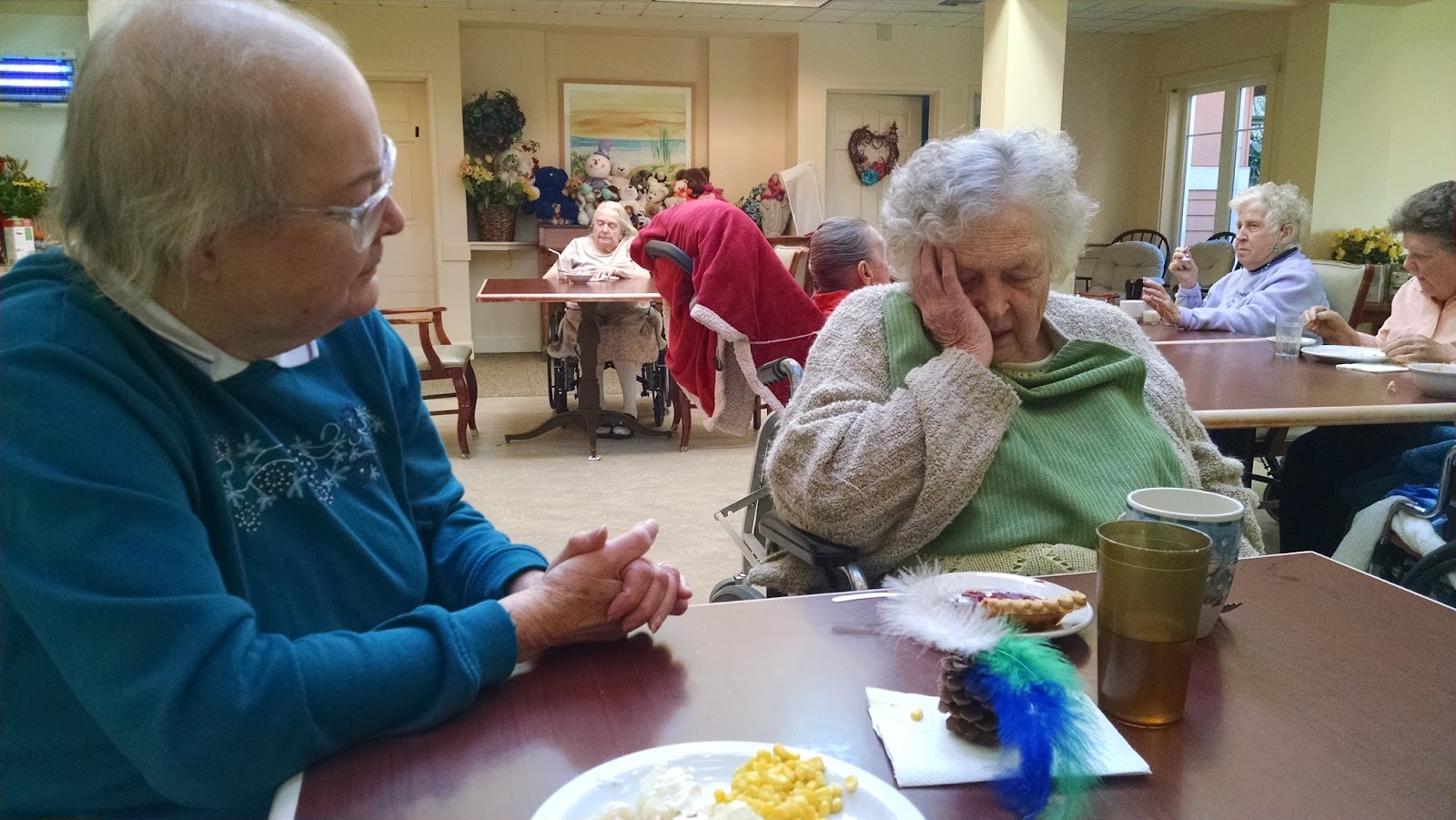
Jean tries to converse with a very tired and reluctant Mama.


She had been quite alert, according to the two of them, but what I saw was her very tired self, again.  I was able to put some slippers on her, as she had refused them earlier.  She then decided she was going to powernap, and as she did Noelle and I were able to conference over medications and other whatnots dealing with the Mater.
IMG_20151127_125433521.jpg
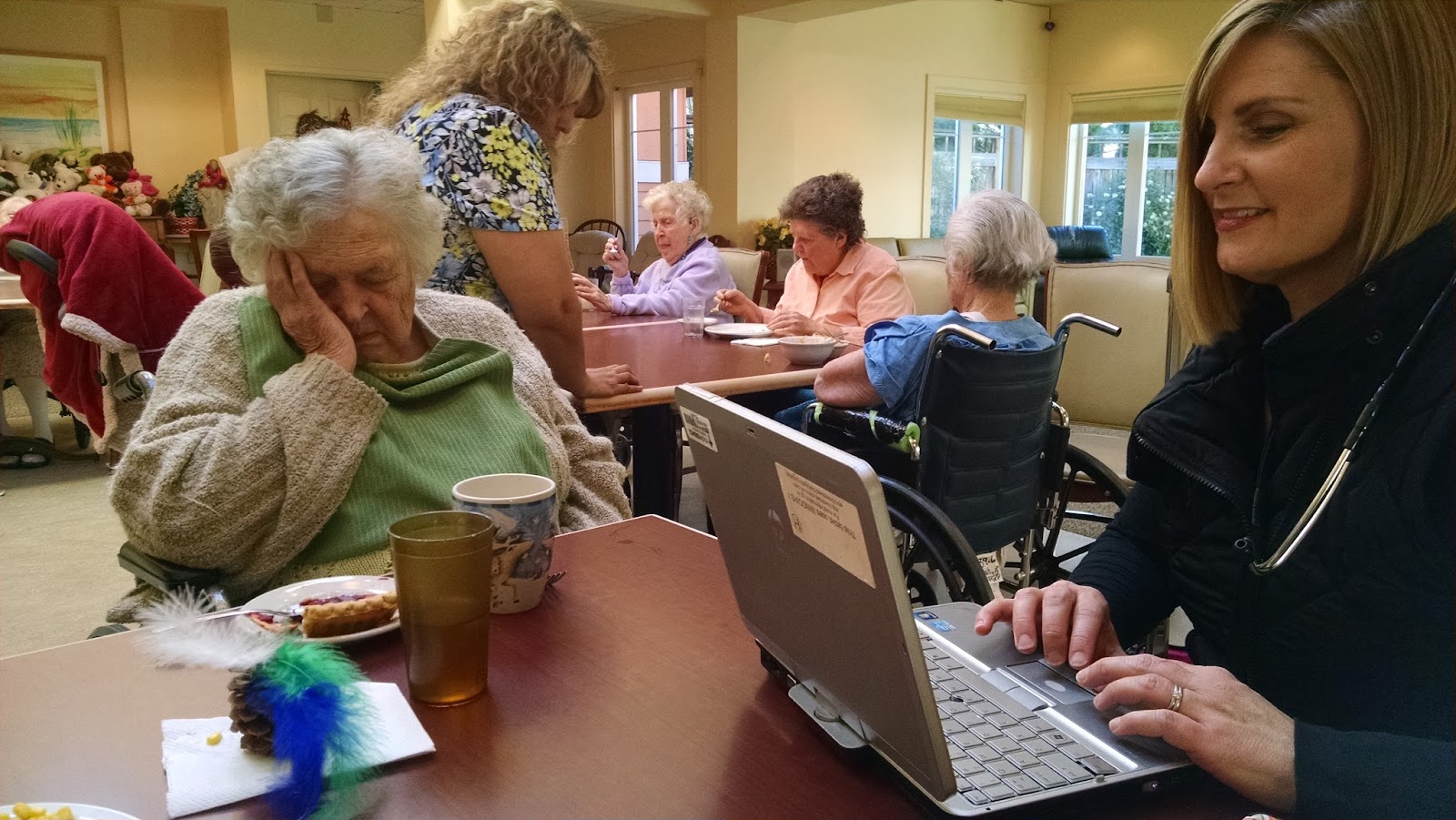
Mom power naps while Noelle works on her report


Saturday found Mother quite tired.  She had been given some medication to help with constipation and it worked - during the night - all night.  She had made it to the loo twice with no help, and the rest of the time staff was able to aid her.  They did help her back to bed, as she was quite unsteady on her feet.  

My brother and his son had just arrived from Washington to see her around 11, but as she was still abed, it seemed reasonable for them to return later.   I mentioned she seemed quite alert and bright when she greeted them.  “That was alert?” my brother inquired.  I affirmed my statement.  And, to be honest, she was the most chipper I’d seen her in a while, and she’d been awakened by our presence.  
My brother and son returned later and had a nice visit with her.  She still didn’t eat much - only half her lunch.  

Later that evening, I received a call.  Mom had just punched the med-aide 3 times while she was trying to give her the medications, and to put Mom in her wheelchair.  Mother was quite belligerent!   She complained she didn’t need any pills!  and she could stand on her own two feet (which she was doing when the aide walked in).  The aide quickly pushed the chair behind Mom and suddenly Mom began to fall backward - luckily into the chair.  Whew!

On Sunday, Mom was determined to walk to breakfast.  She did, with help.  She refused the walker and the wheelchair.   She ate abotu 80% of her breakfast, and then went to her room to rest. And rest she did. She did not come out until dinner.

For dinner, Mom used the wheelchair, as her legs simply wouldn't comply, and she gladly rode to the table. And this is where I'll leave you for this week.

Stay tuned for more!


IMG_20151018_142407073.jpg
Mom and her friends in the '70's:  L-R Mom, Florence Fletcher, Martha Lou Magin, Unknown. 2nd Row: Bobby Harrah and 3 Unknown ladies.

Thursday, November 26, 2015

What To Be Thankful For This Thanksgiving

Thanksgivings at home were always fraught with the aromas of turkey, gravy, cake, cookies, and the sounds of dedicated cooking - with the occasional fracas - well, a lot of fracases (should that be fraci?)  But as I grow older I have come to realize, especially this year, what there is to be truly grateful for:

Waking up in the morning
Breathing
Knowing there are others about - somewhere
A Clear Mind
The Ability to Sense
The Ability to Communicate
Movement
Rising from Bed
A Good Shower
Food in the Belly
Clothes on the Body
A Smile
Knowing Others Are Available for Help When Truly Needed

These are only a few.  But they form the basis of our lives.

I'm grateful Mom is safe, has people attending to her needs, has people who care and move with her whims.

It is a bit bleak to understand there is so little she understands, and yet she is content and not suffering.  That, in itself is a blessing.

For all this, I am grateful.  And we are all truly blessed. 

Tuesday, November 24, 2015

The Final Stages of Lewy Body Dementia - What To Expect

The skies were wracked with clouds today; the sun trying to shine through.  Before I left to see Mom I received a snap in a text that showed her smiling and out of her room.  The sun began to shine outside.

The past few days have been something of a torment.  Mom had been doing so very well, and then the chair incident from last Tuesday.  From there we went to less food, less interaction, and finally her not being able to walk or stand on her own.   

Today, Mom had a very soft voice - nearly unintelligible.  She ate very little (probably about 50% breakfast and <10% lunch, but did eat afternoon snack).  She was so very tired, but they kept her in the great room so she would be stimulated and wouldn’t just sleep, as she did all weekend.

This was not the woman I remember, but I know she’s in there somewhere.  And, as I begin to line the final ducks up in their row, I wanted to understand the final phase of Lewy Body Dementia.  Are we truly there?  Are we really undergoing that transition?  

According to the Alzheimer’s North Carolina:
  • By the end of the disease, the person will typically be bedbound or will need specialized seating in a reclining seating system. Rigidity and stiffness are very common and make movement and care very difficult for both the caregiver and the person with DLB. The person is able to move little and requires major amounts of physical help for all care and engagement in preferred activities. The person may find touch uncomfortable and painful, even if it is delivered slowly and gently. The person typically has a very difficult time communicating. Speech is very soft and indistinct and often off target or repetitive in nature. (DLB)
This is almost Mom at this time, except for the touch.  Mom liked it when I stroked and held her hands today.  

Mom is now going to be using a wheelchair, as she can no longer support her own weight.  She cannot walk - she needs at least 2 aides to move from place to place.  

When Mom ate, it was either by my feeding her, or her trying, but she kept dropping spoons and losing her grip on the dish.  The strength she had last Monday has left her.  

As I stated earlier, her voice is very quiet.  If she weren’t out in the great room, she would be in bed, asleep.  

So, what’s next?   More of the same, but incrementally becoming more pronounced in its presentation:  
  • Death is typically a result of pneumonia or other infection, which the body cannot fight off even with the use of antibiotics. Pneumonia is typically caused by aspiration (food or liquids getting into the airway due to problems with eating or drinking and breathing regulation). Other infections can be localized (repeated UTIs (urinary tract infections), open pressure ulcers or wounds (caused by the inability to move or friction with repeated movements), skin injuries (when hitting a hard or sharp surfaces or skin exposure to urine or feces), or contractures (tightening and shortening of muscles that keep body parts closed together), the use of tubes or catheters (feeding tubes or urinary catheters). Still other infections can be or systemic, called sepsis, an infection in the blood stream.  Other causes of death include malnutrition and dehydration, complications following falls (head injury or fractures), pulmonary emboli (clots that travel to the lungs due to prolonged immobility), or heart failure.(DLB)

This is the part I must be ready to face.

Knowing that Mom is in hospice, and also receives some of the best palliative care possible, makes me glad that I know she’s comfortable and well cared for.   

One question that seemed to come up in my conversations with the hospice staff was ‘Why was she punching so many people for no reason?’  Well, according to livestrong.com, in the final stages of LBD Anxiety, depression, emotional ability and aggression are common in late-stage LBD.Final Stages of Lewy Body Dementia
I guess that answers that!

The best information, though, came from the blog The Lewy Body Rollercoaster (Nearing the End of the LBD Journey)  This helps answer so much, and also offers what we might expect in the next weeks/days:   This was posted by the Whitworths, authors of some of the books recommended on this blog.  

Saturday, April 21, 2012

Nearing the End of the LBD Journey

We received a question recently about how end-stage Alzheimer's (AD) and LBD differ, and what to be concerned about. By the time a person reaches end-stage dementia, there’s so much damage that it’s all very similar and you may not see much difference. These are some of the differences you might see along with some suggestions about care:
Cognition degeneration: Both AD and LBD are degenerative dementias. That is, cognitive abilities will gradually decrease over time.
o   LBD’s characteristic fluctuations between awareness and confusion continue even into this late stage, albeit, few and far between. It is not unusual for patients to know their family members just before death. Look for these and take advantage of them for a final goodbye. However, remember that by now, your loved one will not be able to communicate well.
·         Communication: Eventually any dementia patient will lose the ability to communicate through the normal channels of talking and facial expressions. However, there’s research saying that comprehension is the last ability to go, and so continue talking to your loved one and assume understanding. Remember that touch continues to be important, as does a loving tone of voice. In addition, don’t talk about them or argue with others in their presence anymore than you would if they were responding.
o   LBD weakens facial muscles, thus talking and facial expressions become difficult often well before the end stages. Add LBD’s larger share of confused thinking.  The result is that much earlier than with AD, LBD folks may stop trying to communicate through normal channels. Behavior becomes the main form of communication.
·         Acting out behaviors: Consider acting-out behaviors the body’s call for help. They usually become more intense as normal channels of communication fail. Look for physical and/or environmental reasons for the behavior: pain, too much stimulation (light, sound, etc.) See previous blogs, and our book, The Caregiver’s Guide to Lewy Body Dementia.
o   LBD affects thinking early on, thus acting-out due to delusions can be a very early, sometimes first symptom. LBD-related symptoms such as hallucinations and acting-out behaviors will increase as communication becomes more difficult. However, they may change in form. With degenerating health, agitation and restlessness may be the most common “acting-out” behaviors.
·         Sleeping. People with any kind of dementia tend to sleep more and more as the end nears—20 hours a day is more the norm than not. If your loved one is restless or agitated at this stage, consider this “acting-out behavior” rather than a sleep problem.
·         General health: Eventually any degenerative dementia will cause a body to become incapacitated and die.
o   LBD is more than a cognitive disorder. As already mentioned, its effect on muscles makes communication difficult. It can also weaken other muscles, and it can affect physical health right from the beginning. Therefore, complications like pneumonia, urinary tract infections or falls can be life threatening.  Good patient care and early detection of problems become very important. Consider increased acting-out a signal that something is not right. Check for UTI’s, constipation, or other signs of discomfort. If you can find and remove the irritant, the restlessness should decrease.
·         Life expectancy: If there are no complications, a person with dementia can live for many years before enough brain cells have died to shut everything down—often 20 years or more.
o   LBD patients usually do have complications. Therefore, life expectancy is short: 2 to 7 years after diagnosis. However, LBD is seldom diagnosed until well into the disease process. Life expectancy from the first LBD symptom remembered by spouse or family would likely be similar to AD’s 15-20 years—perhaps longer with good care.
I will be posting more research as it comes up, but also updates on Mom, so stay in touch!

Reading/Research: